

AI in omnichannel marketing: Why the tools aren’t the problem – it’s the integration
AI has long since made its mark in marketing – at least on the surface. In many retail companies, tools for product descriptions, translations or simple image generation are now part of everyday life. But this is precisely where the real challenge begins: using AI is no longer a competitive advantage, but the norm.
What sounds like a simple ‘AI transformation’ at conferences often feels more like fragmentation within the company. Teams work with different tools, results are difficult to compare, and instead of efficiency gains, new coordination efforts arise. At the same time, the pressure is growing to manage more and more channels – faster, more personalised and with fewer resources.
The real challenge, therefore, is not the use of AI itself, but rather the question: how can AI be effectively integrated with existing systems and processes? This is precisely where leading retail companies are focusing their efforts – building not isolated solutions, but integrated, AI-powered content ecosystems.
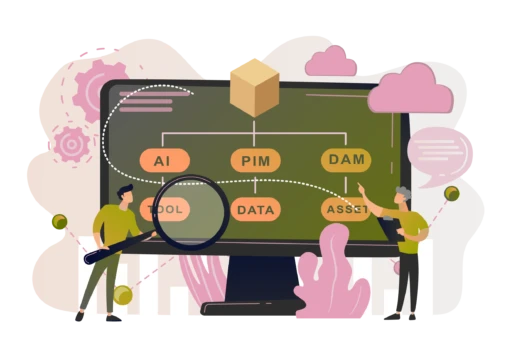
Marketing teams are facing a new level of complexity: which AI tools are actually useful? Which ones can be seamlessly integrated with existing PIM and DAM systems? And how do you prevent ten individual AI solutions from quickly turning into an unmanageable proliferation of tools? Added to this are very practical questions that are often underestimated in day-to-day operations: licensing models, API costs, usage limits, data protection requirements and integration into existing workflows.
The real bottleneck: integration rather than innovation
Many marketing planners underestimate a key issue:
It is not the quality of the AI that is the limiting factor – but its integration.
Typical challenges:
- AI tools lack a clean API
- Data from the PIM is not transferred cleanly
- Assets do not end up in the DAM in a structured manner
- Results cannot be versioned
This leads to a situation familiar to many: AI is being used – but not at scale.

Which AI tools do marketing planners really need today?
The question is no longer whether AI is used – but where it has the greatest impact within the process. Because the key point is this: value is not created by individual tools, but through their interaction.
| Category |
What it’s really about | Typical everyday benefits |
| Creative AI | Scaling of advertising materials | Variations for campaigns, rapid ad creation |
| Text AI | Structured content production | Product descriptions, localisation, campaign slogans |
| Video AI | Automated video creation | Social media content, in-store screens |
| Performance AI | Data-driven optimisation | Better conversion rates, reduced wastage |
| Automation & Integration | Integration of all systems | Seamless workflows |
Rather than listing the results, it is worth looking ahead: what would the same process look like if AI were properly orchestrated?
Orchestrated target process (simplified):
1. Trigger in PIM: new or modified product (e.g. price, product range, promotion)
2. Rule-based enrichment: Attributes are checked, missing data automatically supplemented (taxonomies, mandatory fields)
3. AI generation (context-based):
-
-
- Product texts per channel (e-commerce, brochure, social media)
- Image variants from existing assets (e.g. scenes, backgrounds)
- Claims/USPs per target group
-
4. Versioning in DAM:
All assets are stored in a structured manner (including metadata, variants, language versions)
5. Template-based advertising material production:
Brochure pages, banners and newsletters are automatically populated from templates
6. Channel distribution & feedback:
-
-
- Publishing in shop, print and social media
- Performance data is fed back (closed loop)
-
The difference is not ‘more AI’, but clear orchestration along a consistent data and process model.
What this means in practical terms for marketing planners
The real change is taking place within existing omnichannel systems – not alongside them.
Where automated processes already exist (e.g. template-based brochure production, rule-based management of product ranges), AI can provide targeted reinforcement:
1. Context rather than individual functions
- AI accesses PIM data directly (attributes, prices, promotions)
- Generation is channel-specific (not ‘one text for all’)
- Brand and campaign rules are taken into account by the system
2. Automated variant creation
- Multiple display variants are automatically generated from a single product
- Differences by channel, region, target group
- A/B testing logic can be implemented directly within the system
3. Closed feedback loops
- Performance data (e.g. CTR, sales) is fed back
- AI iteratively adapts content (claims, image selection, prioritisation)
- Decisions are data-driven rather than “gut-driven”
4. Governance & scaling
- Centralised rules prevent uncontrolled growth (approvals, versions, rights)
- Traceability (who generated/adapted what and when?)
- Scaling across product ranges and countries
What marketing planners should bear in mind:
-
-
- Think API-first: Only AI that can be integrated delivers real added value
- Data quality before AI: Poor PIM data = poor results
- Set up template logic properly: AI populates templates – it does not replace them
- Keep an eye on costs: Token/API usage scales with volume
- Data protection & rights: Particularly with generative images/people
-
This article was created with the help of AI.
Related Posts

Maximising Retail Media ROI: How data-driven decisions optimise PIM, DAM and marketing performance
In an industry where retail media is one of the fastest-growing advertising channels, success is no longer determined by creativity or gut instinct – but by data.

AI in marketing: How collaboration tools are reinventing the retail sector
Retail is changing – not because of products, but because of teamwork. Find out how collaboration tools, AI and change management are breaking down silos and strengthening omnichannel strategies.
Detect data errors with AI before the campaign launch
The more complex campaigns become, the more critical the quality of the underlying data becomes. Even small errors in target groups, product data or personalization logics can lead to significant sales losses, damage to the image or unnecessary marketing costs